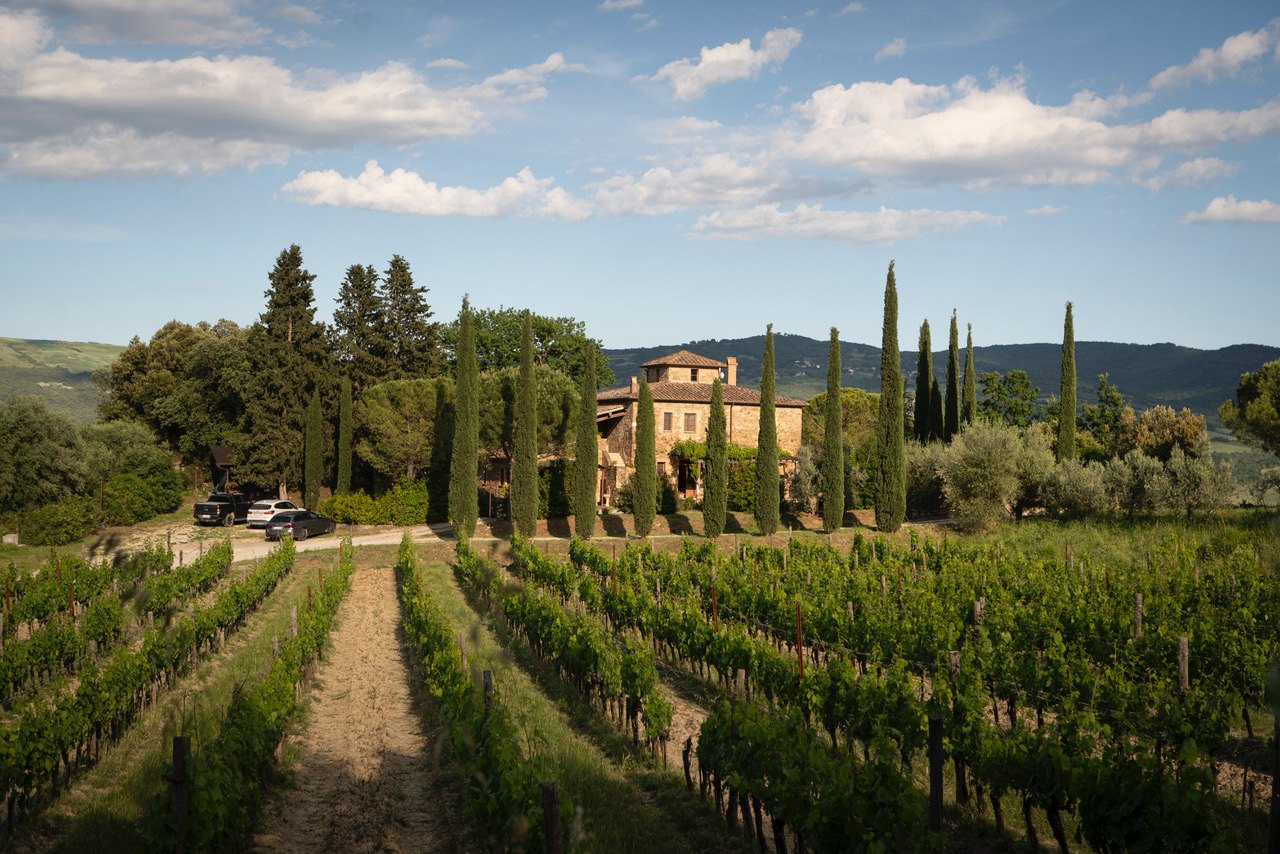
Molino di Sant’Antimo, Castelnuovo dell’AbateMolino di Sant’Antimo, Castelnuovo dell’Abate
Molino di Sant’Antimo: een ambachtelijke aanpak bij elk oogstjaar
Bij Molino di Sant’Antimo betekent “ambachtelijk” niet alleen een klein wijnhuis. Het beschrijft een manier van wijn maken waarbij beslissingen niet uit een vaste formule komen, maar uit de wijngaard en uit de omstandigheden van dat ene jaar.
Het domein teelt elf hectare in Castelnuovo dell’Abate, in het zuidoosten van Montalcino. De wijngaarden zijn biologisch gecertificeerd sinds 2015, de kelder sinds 2025. Op die schaal kunnen zij elk perceel volgen en, waar nodig, het werk in wijngaard en kelder aanpassen.
Het doel blijft hetzelfde: frisheid, elegantie en balans. Wat van jaar tot jaar verandert, is de weg ernaartoe.
De oogstjaren 2020 tot 2025 laten dat goed zien.
2020 – Frisheid bewaren in een warm jaar
2020 was een warm oogstjaar, vooral in de zomer. In het zuidoosten van Montalcino, van nature een van de warmere delen van de appellatie, lag de uitdaging niet bij rijpheid maar bij balans.
In de wijngaard betekende dat extra aandacht voor het bladwerk en bescherming tegen te veel zon, met zorgvuldig volgen van de rijping om overrijpheid te vermijden.
In de kelder vroeg het karakter van de druiven om behoud van de frisheid die al in het fruit zat, niet om meer concentratie of extractie.
Het jaar gaf vanzelf gulheid en rijpheid. De rol van de wijnmaker was dus niet meer gewicht toe te voegen, maar die rijkdom naar balans te begeleiden.
2021 – Een vanzelf gebalanceerd jaar laten spreken
2021 was zeer droog, maar het seizoen bood gunstige omstandigheden voor een geleidelijke en volledige rijping van Sangiovese, vooral in de laatste fase.
In de wijngaard stond voorop: geen onnodige stress, en het evenwicht van de stokken bewaren in de droogste periodes.
In de kelder vroegen druiven met goede concentratie, gezond fruit en gebalanceerde rijpheid om minder correctie en meer terughoudendheid. Niet de wijn construeren, maar de precisie en het natuurlijke evenwicht van het jaar bewaren.
2021 is daarmee een goed voorbeeld van een ander aspect van ambachtelijk werken: weten wanneer je ingrijpt, en wanneer niet.
2022 – Van koers veranderen als het seizoen verandert
2022 begon als een extreem heet en droog jaar. In juli werden hitte en waterstress de dominante zorgen. Regen eind juli en begin augustus veranderde de omstandigheden echter sterk en liet de stokken herstellen.
In de wijngaard vroeg het eerste deel van de zomer om bescherming tegen hitte en te veel stress. Na de regen moest de aanpak om: de stokken herstelden, de rijping hervatte, en de druiven hadden tijd nodig.
In de kelder was de uitdaging bij fruit uit een warm jaar: energie en frisheid vasthouden, de natuurlijke concentratie begeleiden zonder zwaarte.
Die mogelijkheid om tijdens hetzelfde seizoen van koers te veranderen is misschien een van de duidelijkste vormen van ambachtelijk werk. Beslissingen kun je niet maanden van tevoren vastzetten en herhalen. De wijngaard moet je voortdurend volgen.
2023 – Selectie en precisie
2023 was bijna het tegendeel van 2022. Veel voorjaarsregen zorgde in heel Montalcino voor hoge ziektedruk en maakte het werk in de wijngaard veeleisend, zeker in biologische teelt.
In de wijngaard werd timing doorslaggevend. Vaak kijken, zorgvuldig bladwerk, en kunnen ingrijpen in korte droge ramen tussen regenbuien. De van nature goede ventilatie en drainage in delen van het zuidoosten hielpen, maar het jaar vroeg nog steeds veel aandacht.
In de kelder werd selectie bijzonder belangrijk. In een moeilijk jaar is het doel niet te compenseren wat de natuur niet gaf. Het is het beste fruit te herkennen en die kwaliteiten te bewaren.
Het resultaat is een andere vorm van balans: minder op concentratie, meer op frisheid, aromatische precisie en finesse.
2024 – Geduld als wijnmakerskeuze
2024 bracht opnieuw andere omstandigheden. Een nat voorjaar werd gevolgd door zomerhitte, terwijl de rijping later in het seizoen niet altijd lineair liep.
In de wijngaard vroeg dat om zorgvuldig volgen, niet om vaste oogstdatums. Percelen konden in tempo verschillen, waardoor het moment van plukken extra belangrijk werd.
In de kelder vroegen druiven uit een frisser en minder homogeen seizoen om respect voor hun delicatere profiel. Het doel bleef hetzelfde – elegantie, frisheid en balans – maar de route ernaartoe was anders dan in een van nature rijker jaar als 2020 of 2022.
Soms betekent begeleiden handelen. Soms wachten. In 2024 werd geduld zelf onderdeel van de ambachtelijke aanpak.
2025 – Bewaren wat de natuur al heeft bereikt
2025 bracht meer gebalanceerde omstandigheden, met voldoende water en gunstige temperatuurverschillen in de laatste fase van de rijping.
In de wijngaard ging het werk daarom minder over reageren op een extreem, en meer over het evenwicht bewaren dat zich vanzelf had ontwikkeld.
In de kelder geldt hetzelfde. Als gezonde druiven aankomen met frisheid, aromatische definitie en gebalanceerde rijpheid, is de rol van de kelder niet om extra karakter op te leggen, maar te beschermen wat er al is.
Dat is misschien de stilste vorm van ambachtelijk wijn maken: begrijpen dat ingrijpen niet automatisch synoniem is van kwaliteit.
Het doel blijft hetzelfde. De weg ernaartoe niet.
Deze oogstjaren naast elkaar zetten maakt de filosofie helderder.
Een warm jaar vraagt misschien om bescherming en terughoudendheid. Een droog jaar vraagt aandacht voor het evenwicht van de stok. Een nat jaar vraagt precisie en selectie. Een delicaat jaar kan geduld vragen. En een van nature gebalanceerd jaar mag soms gewoon zichzelf zijn.
Hetzelfde principe geldt in de kelder. Extractie, maceratie, rijping en de vele kleine keuzes tijdens de vinificatie kun je niet herhalen omdat ze vorig jaar werkten. Ze moeten antwoorden op het fruit dat werkelijk in de kelder komt.
Frisheid, elegantie en balans blijven het doel bij Molino di Sant’Antimo. Maar consistentie betekent geen identieke wijnen.
Het betekent een vaste filosofie, terwijl elk oogstjaar zijn eigen identiteit houdt.
Dat is misschien de kern van ambachtelijk wijn maken: niet elk jaar dezelfde wijn proberen te maken, maar elk jaar begeleiden naar de beste en meest authentieke expressie die het kan geven.
Molino di Sant’Antimo: An artisanal approach to every vintage
At Molino di Sant’Antimo, “artisanal” does not simply mean being a small winery. It describes an approach to wine in which decisions are not dictated by a fixed recipe, but by the vineyard and by the conditions of each individual year.
The estate cultivates 11 hectares in Castelnuovo dell’Abate, in the south-eastern part of Montalcino. The vineyards have been organically certified since 2015 and the winery since 2025. Working on this scale makes it possible to follow each vineyard closely and, when necessary, adapt the work both in the vineyard and in the cellar.
The objective remains consistent: freshness, elegance and balance. What changes from year to year is the way to achieve it.
The vintages from 2020 to 2025 illustrate this particularly well.
2020 – Preserving freshness in a warm year
2020 was a warm vintage, particularly during the summer. In the south-eastern part of Montalcino, where conditions are naturally among the warmer ones in the denomination, the challenge was not achieving ripeness but preserving balance.
In the vineyard, this meant paying particular attention to the canopy and to protecting the grapes from excessive exposure, while monitoring maturation carefully in order to avoid over-ripeness.
In the cellar, the character of the grapes called for an approach aimed at preserving the freshness already present in the fruit rather than increasing concentration or extraction.
The vintage naturally gave generosity and ripeness. The role of the winemaker was therefore not to add more weight, but to accompany that richness towards balance.
2021 – Allowing a naturally balanced vintage to express itself
2021 was very dry, but the growing season offered favorable conditions for a gradual and complete maturation of Sangiovese, particularly during its final stages.
In the vineyard, the priority was to avoid unnecessary stress and preserve the natural equilibrium of the vines during the driest periods.
In the cellar, grapes arriving with good concentration, healthy fruit and balanced maturity required less correction and more restraint. Rather than trying to construct the wine, the objective was to preserve the precision and natural balance of the vintage.
2021 is therefore a good example of another aspect of artisanal winemaking: knowing when to intervene, but also knowing when not to.
2022 – Changing approach when the season changes
2022 began as an extremely hot and dry vintage. By July, heat and water stress had become the dominant concerns. Rain between the end of July and beginning of August, however, substantially changed the conditions of the vineyards and allowed the vines to recover.
In the vineyard, the first part of summer required protection from heat and excessive stress. After the rain, the approach had to change: the vines had recovered, maturation had resumed, and the grapes needed time.
In the cellar, the challenge with fruit from a warm year was to retain energy and freshness, accompanying the natural concentration of the vintage without allowing it to become heaviness.
This ability to change direction during the same growing season is perhaps one of the clearest expressions of artisanal work. Decisions cannot be made months in advance and simply repeated. The vineyard has to be observed continuously.
2023 – Selection and precision
2023 was almost the opposite of 2022. Frequent spring rainfall created considerable disease pressure throughout Montalcino and made vineyard management particularly demanding, especially under organic farming.
In the vineyard, timing became fundamental. Frequent observation, careful management of vegetation and the ability to intervene during relatively short windows between periods of rain were essential. The naturally good ventilation and drainage found in parts of the south-eastern sector could help, but the vintage still demanded considerable attention.
In the cellar, selection became particularly important. In a difficult year, the aim is not to compensate for what nature has not provided. It is to identify the best fruit and preserve its qualities.
The result is a different expression of balance: potentially less based on concentration and more on freshness, aromatic precision and finesse.
2024 – Patience as a winemaking decision
2024 again presented different conditions. A wet spring was followed by summer heat, while maturation later in the season was not always linear.
In the vineyard, this required careful monitoring rather than relying on predetermined harvest dates. Different parcels could progress at different speeds, making the decision of when to pick particularly important.
In the cellar, grapes from a fresher and less homogeneous season required an approach respectful of their more delicate profile. The objective remained the same – elegance, freshness and balance – but the route towards it was different from that of a naturally richer year such as 2020 or 2022.
Sometimes accompanying a vintage means acting. Sometimes it means waiting. In 2024, patience itself became part of the artisanal approach.
2025 – Preserving what nature has already achieved
2025 brought more balanced conditions during the growing season, with good water availability and favorable temperature differences during the final stages of maturation.
In the vineyard, the work was therefore less about reacting to an extreme condition and more about preserving the equilibrium that had developed naturally.
In the cellar, the same principle applies. When healthy grapes arrive with freshness, aromatic definition and balanced maturity, the role of winemaking is not to impose additional character, but to protect what is already there.
This is perhaps the quietest expression of artisanal winemaking: understanding that intervention is not automatically synonymous with quality.
The aim stays the same. The way to reach it does not.
Looking at these vintages side by side makes the philosophy clearer.
A warm year may require protection and restraint. A dry year requires attention to the equilibrium of the vine. A wet year demands precision and selection. A more delicate year may require patience. And a naturally balanced year may simply need to be allowed to express itself.
The same principle continues in the cellar. Extraction, maceration, ageing and the many small decisions made during vinification cannot simply be repeated because they worked the previous year. They have to respond to the fruit that actually arrives in the cellar.
Freshness, elegance and balance remain the aim at Molino di Sant’Antimo. But consistency does not mean making identical wines.
It means maintaining a consistent philosophy while allowing each vintage to retain its own identity.
That is perhaps the essence of artisanal winemaking: not trying to make the same wine every year but accompanying each year towards the best and most authentic expression it can give.